

 by
by 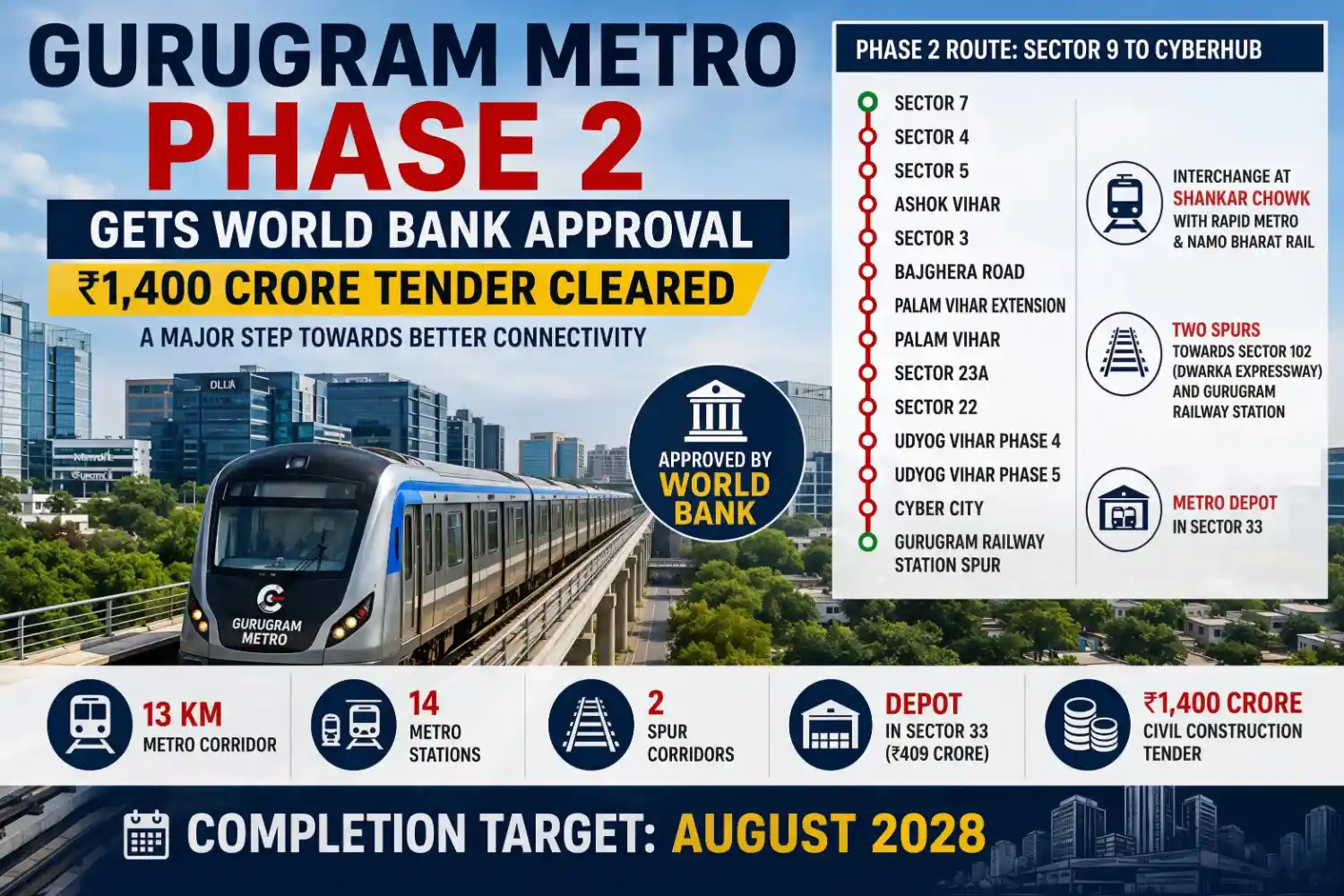
Gurugram is set to witness one of its biggest infrastructure upgrades in recent years as the Gurugram Metro Phase 2 project has received approval from the World Bank for a major civil construction tender worth approximately ₹1,400 crore. The development marks a significant milestone in the expansion of the city’s urban transportation network and is expected to improve connectivity between key residential, commercial, and industrial hubs.
According to Gurugram Metro Rail Limited (GMRL), the approved tender covers the construction of a 13-kilometre metro corridor from Sector 9 to CyberHub, along with 14 metro stations and supporting infrastructure. With a targeted completion date of August 2028, the project is expected to transform daily commuting patterns while boosting real estate growth across several sectors of Gurugram.
In this article, we take a detailed look at the Gurugram Metro Phase 2 project, its route, stations, connectivity benefits, construction timeline, economic impact, and what it means for residents, businesses, and property investors.
Gurugram Metro Phase 2 Receives Major Boost
The approval from the World Bank allows GMRL to float a civil construction tender for the next phase of the metro project. The tender is estimated at around ₹1,400 crore and includes the construction of the elevated metro corridor and stations.
Officials from GMRL have confirmed that groundwork preparations have already been completed and the tender process is expected to move forward quickly. The approval is considered a major achievement because it strengthens financial confidence in the project and ensures smoother execution of construction activities.
The metro expansion is part of Gurugram’s broader vision to create a modern, integrated public transport network capable of supporting the city’s rapidly growing population and commercial activity.
What is Gurugram Metro Phase 2?
Gurugram Metro Phase 2 is the second segment of the city’s independent metro project being developed by Gurugram Metro Rail Limited.
The project involves:
- A 13 km elevated metro corridor
- 14 metro stations
- Two additional spur lines
- Integration with Rapid Metro
- Interchange connectivity with Namo Bharat Rail
- Improved access to major residential and business districts
The corridor will extend from Sector 9 to CyberHub and connect multiple high-density areas that currently face significant traffic congestion.
Gurugram Metro Phase 2 Route Details
The proposed metro route will connect several important sectors and urban centers across Gurugram.
Proposed Stations
The corridor will include the following stations:
- Sector 7
- Sector 4
- Sector 5
- Ashok Vihar
- Sector 3
- Bajghera Road
- Palam Vihar Extension
- Palam Vihar
- Sector 23A
- Sector 22
- Udyog Vihar Phase 4
- Udyog Vihar Phase 5
- Cyber City
- Gurugram Railway Station Spur
These stations have been strategically planned to serve both residential neighborhoods and commercial districts.
The route will significantly improve accessibility for thousands of daily commuters traveling between western Gurugram, Cyber City, Udyog Vihar, and nearby employment hubs.
Integration with Rapid Metro and Namo Bharat Rail
One of the most important features of the project is its planned integration with existing and upcoming transportation systems.
At Shankar Chowk, passengers will be able to interchange between:
- Gurugram Metro
- Rapid Metro
- Namo Bharat Rail (RRTS)
This multimodal connectivity is expected to reduce travel times dramatically and make public transportation a more attractive alternative to private vehicles.
For professionals working in Cyber City and Udyog Vihar, this interchange will create a seamless commuting experience across Delhi-NCR.
Two Additional Spur Corridors
Apart from the main route, the metro project will also include two strategic spur lines.
Sector 102 Spur
The first spur will extend toward Sector 102 near the Dwarka Expressway.
This corridor is expected to support rapidly developing residential projects and improve connectivity to one of the most important real estate growth corridors in NCR.
Gurugram Railway Station Spur
The second spur will connect the metro network directly to Gurugram Railway Station.
This connection will benefit intercity travelers and create a stronger transportation ecosystem by linking rail and metro services.
Why World Bank Approval Matters
The World Bank’s approval is more than just a financial milestone.
It brings:
- Enhanced project credibility
- Better financial oversight
- Improved project execution standards
- International quality benchmarks
- Increased investor confidence
Infrastructure projects backed by global financial institutions often receive stronger monitoring and project management support, helping reduce delays and improve construction quality.
For Gurugram, this approval reinforces confidence in the city’s long-term infrastructure development strategy.
Completion Timeline: August 2028 Target
GMRL has set August 2028 as the completion deadline for Phase 2.
The timeline includes:
2026
- Tender approval
- Contractor selection
- Initial construction activities
2027
- Large-scale civil construction
- Station development
- Utility shifting and infrastructure work
2028
- Testing and commissioning
- Safety inspections
- Metro operations launch
Officials have expressed confidence that construction activities can proceed according to schedule if all supporting agencies continue coordination efforts.
Metro Depot Tender to be Re-Floated
Alongside the Phase 2 construction tender, GMRL has also announced plans to re-float the tender for the proposed metro depot in Sector 33.
Earlier, only one bidder qualified for the project, leading authorities to reconsider the tender process.
The metro depot project is estimated at approximately ₹409 crore and includes:
- Depot construction
- Maintenance facilities
- Operations control infrastructure
- Workshop facilities
The depot will play a critical role in ensuring efficient metro operations once the network becomes functional.
Challenges Facing the Project
Despite receiving approval, several challenges remain.
Utility Shifting
Authorities are working with:
- National Highways Authority of India (NHAI)
- Haryana Vidyut Prasaran Nigam
- Gurugram Metropolitan Development Authority (GMDA)
to expedite the relocation of utilities that could affect construction timelines.
Power Infrastructure
Officials are also coordinating the removal and relocation of electrical infrastructure, including power substations that fall within the project alignment.
Drain Reconstruction
A major concern along parts of the route involves drainage infrastructure.
Authorities have prioritized work on the Leg One drain and related reconstruction activities to ensure that metro construction can proceed without delays.
Impact on Traffic Congestion
Traffic congestion remains one of Gurugram’s biggest urban challenges.
Areas such as:
- Shankar Chowk
- Udyog Vihar
- Cyber City
- Palam Vihar
- Sector 22
regularly experience heavy traffic during peak hours.
The new metro corridor is expected to:
- Reduce dependency on private vehicles
- Lower road congestion
- Improve travel reliability
- Enhance public transportation usage
As more commuters shift to metro travel, road pressure across major intersections is likely to decrease substantially.
Economic Benefits of Gurugram Metro Phase 2
Large-scale infrastructure projects generate economic growth far beyond transportation improvements.
Job Creation
Construction activities will create employment opportunities across:
- Engineering
- Construction
- Project management
- Operations
- Maintenance
Business Growth
Better connectivity often leads to:
- Increased commercial activity
- Higher office occupancy rates
- New business investments
- Improved retail performance
Productivity Gains
Reduced travel times translate into improved workforce productivity and lower transportation costs.
Real Estate Impact of Gurugram Metro Expansion
The Gurugram Metro Phase 2 project is expected to have a significant impact on the city’s real estate market.
Historically, metro connectivity has played a major role in increasing property values across Delhi-NCR.
Areas Likely to Benefit
Some of the biggest beneficiaries include:
- Palam Vihar
- Palam Vihar Extension
- Sector 22
- Sector 23A
- Sector 102
- Ashok Vihar
- Bajghera Road
- Udyog Vihar
- Cyber City
These locations are likely to see increased interest from homebuyers and investors due to improved accessibility.
Dwarka Expressway Advantage
The Sector 102 spur is particularly important because it strengthens connectivity with the rapidly developing Dwarka Expressway corridor.
Several residential and commercial developments in this area could benefit from enhanced metro access in the coming years.
Phase 1 and Phase 2 Together: A Larger Metro Vision
The metro expansion is not limited to Phase 2.
Phase 1 Overview
The first phase connects:
Millennium City Centre to Sector 9
Key facts:
- Length: 13 km
- Cost: ₹1,277 crore
- Construction started in 2025
- Target completion: August 2028
According to GMRL, construction work is already underway and progress is being made on key sections.
Combined Network
Once both phases are complete:
- Total network length: 30.7 km
- Total stations: 28
- Dedicated metro depot in Sector 33
- Multiple interchange facilities
This will create a significantly larger urban transit network capable of serving a broad cross-section of Gurugram’s population.
How the Project Supports Sustainable Urban Development
Modern cities require efficient public transportation systems to manage growth.
The metro expansion supports sustainability goals by:
- Reducing vehicle emissions
- Encouraging public transport usage
- Lowering fuel consumption
- Reducing road congestion
- Supporting transit-oriented development
As Gurugram continues to expand, investments in mass transit systems will become increasingly important for maintaining quality of life and economic competitiveness.
What Residents Can Expect
For residents, the metro project promises several long-term benefits:
- Faster daily commutes
- Better access to employment hubs
- Reduced dependence on personal vehicles
- Improved connectivity to railway and regional transit systems
- Enhanced property values in metro-connected areas
Professionals working in Cyber City and Udyog Vihar are expected to benefit particularly from reduced travel times and improved transportation reliability.
Conclusion
The approval of the Gurugram Metro Phase 2 civil construction tender by the World Bank marks a major milestone in the city’s infrastructure development journey. With a project value of approximately ₹1,400 crore, 14 planned stations, integration with Rapid Metro and Namo Bharat Rail, and a completion target of August 2028, the project has the potential to transform mobility across Gurugram.
Beyond transportation benefits, the project is expected to drive economic growth, improve urban connectivity, support sustainable development, and enhance real estate values in key locations. As construction progresses over the coming years, residents, businesses, and investors will be closely watching the development of Gurugram Metro Phase 2, which is set to become one of the most impactful infrastructure projects in the city’s future.

Join The Discussion