

 by
by 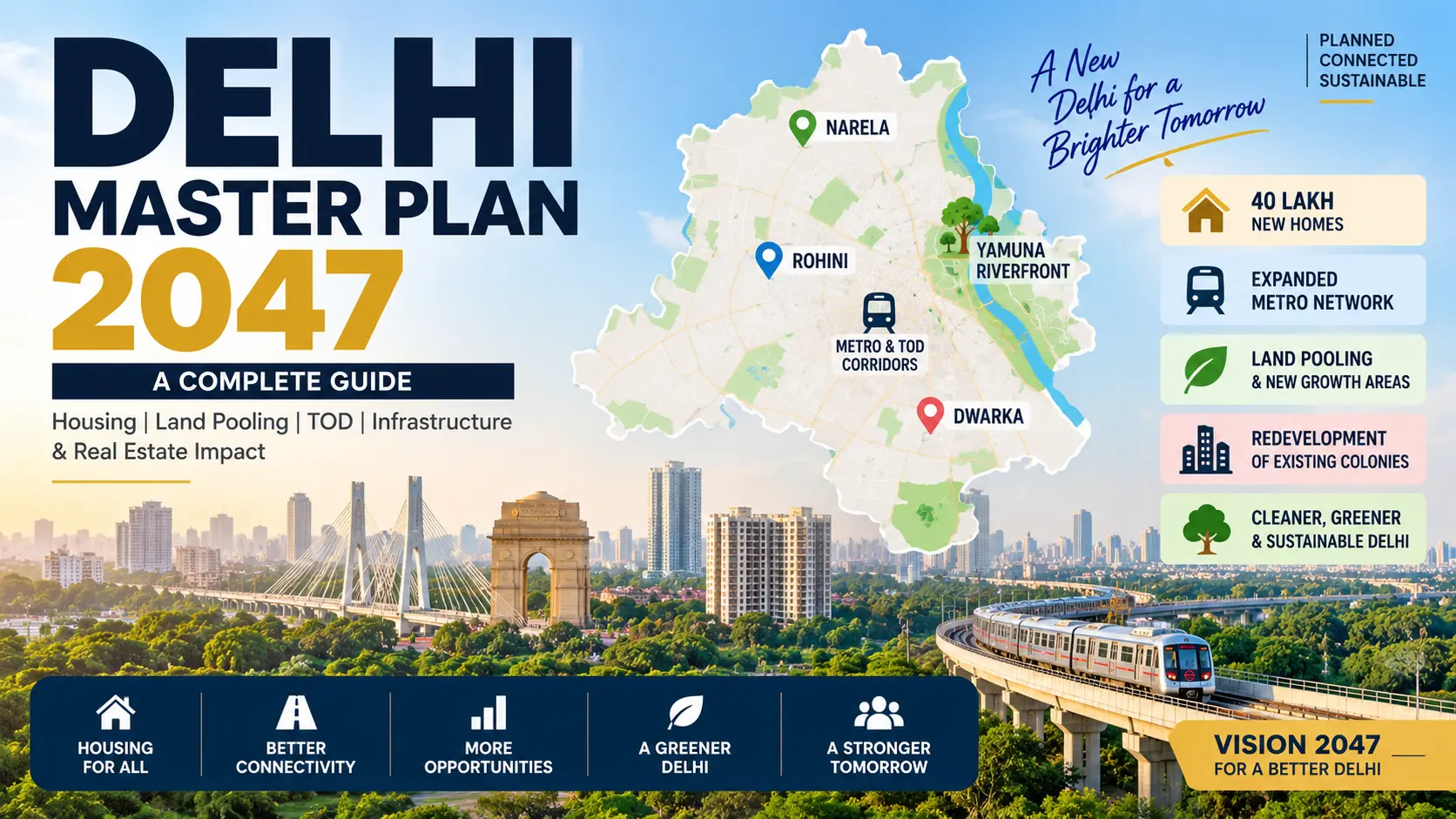
Delhi is entering one of its biggest planning transitions in decades.
The Delhi Master Plan 2047, also known as MPD-2047, is the long-term framework that will guide how the capital grows, redevelops existing neighbourhoods, creates housing, connects people with public transport, supports businesses and protects environmentally sensitive areas.
The plan was officially notified on 20 August 2026 and is intended to guide Delhi’s development towards 2047. It is not simply a housing plan. It covers land use, redevelopment, transportation, employment, industry, environmental protection, infrastructure and governance.
For property buyers and investors, however, there is one important point to understand from the beginning:
A Master Plan tells us where and how development may happen. It does not guarantee project approvals or property appreciation.
The smarter way to read MPD-2047 is to follow planning permissions + infrastructure + connectivity + actual implementation, rather than buying only on future expectations. That same caution is highlighted in the real-estate analysis in the supplied reference.
What Is Delhi Master Plan 2047?
The Master Plan for Delhi 2047 is the statutory planning framework prepared by the Delhi Development Authority and approved by the Central Government.
Its stated vision is to transform Delhi into a globally competitive, environmentally resilient and inclusive capital while preserving its heritage and improving liveability. The official plan works with a long-term population context of nearly 3.2 crore people.
Unlike an approach focused only on outward expansion, MPD-2047 combines two broad models:
Brownfield development: Redevelopment and regeneration of existing Delhi.
Greenfield development: Planned development of new growth areas through tools such as Land Pooling and Low-Density Area policies.
In simple terms, Delhi plans to grow in two directions at the same time:
Rebuild parts of the existing city and create better-planned new urban areas.
Delhi Master Plan 2047: Quick Overview
| Topic | MPD-2047 Direction |
| Planning authority | Delhi Development Authority |
| Notification | 20 August 2026 |
| Planning horizon | 2047 |
| Estimated city population | Around 3.2 crore |
| Housing requirement | Around 40 lakh dwelling units |
| Main growth models | Redevelopment + planned greenfield expansion |
| Key planning tools | TOD, Land Pooling, High Density Corridors, regeneration |
| Transport focus | Metro, RRTS, roads, walking, cycling and multimodal integration |
| Major themes | Housing, jobs, connectivity, ecology and infrastructure |
The official plan estimates that Delhi may require about 40 lakh additional homes up to 2047 to address population growth, changing household sizes and future urban expansion.
1. Housing: Where Can Delhi’s Future Homes Come From?
Housing is one of the biggest parts of MPD-2047.
The plan does not expect all future homes to come from newly developed land. Housing supply can come through multiple channels, including redevelopment of existing neighbourhoods, Transit-Oriented Development, Land Pooling, rehabilitation and other housing formats.
Your supplied MPD-2047 analysis identifies several major housing directions:
- Around 7 lakh additional homes through redevelopment of existing group, DDA and government housing.
- Around 18 lakh affordable homes linked to TOD and transit corridors.
- Around 12 lakh homes through Land Pooling areas.
- In-situ rehabilitation remains an important direction for more than 17 lakh JJ dwellers.
These figures should not simply be added together because different policy mechanisms can overlap. The official planning document itself places housing within a broader combination of redevelopment, regeneration and policy-led development rather than presenting one single source of supply.
What does this mean for homebuyers?
Future housing opportunities may increasingly appear in three types of locations:
Existing colonies suitable for redevelopment,
areas around major public transport corridors, and
new planned development areas on Delhi’s periphery.
But every project will still depend on applicable development controls, infrastructure capacity and approvals.
2. Redevelopment of Old Delhi Colonies Could Be a Major Change
One of the most important real estate stories inside the DDA Master Plan 2047 is redevelopment.
Delhi has a large stock of ageing DDA housing, Cooperative Group Housing Societies, government housing and other older residential developments.
MPD-2047 encourages redevelopment of ageing housing and under-utilised land where infrastructure already exists. The purpose is not simply to replace old buildings, but also to improve roads, utilities, public spaces and community facilities.
Your supplied reference also highlights a major change in the minimum area threshold for residential redevelopment, from 40,000 sq m to 3,000 sq m, potentially making smaller ageing housing parcels more workable.
This could become relevant for many:
- old group housing societies,
- ageing DDA colonies,
- government housing,
- older residential blocks,
- and suitable commercial centres.
However, redevelopment does not mean unlimited construction.
Building height and development potential will continue to depend on factors such as FAR, road width, fire norms, structural safety, aviation restrictions and infrastructure capacity.
3. Transit-Oriented Development: Why Metro Stations Matter More Now
One of the strongest concepts in Delhi Master Plan 2047 is Transit-Oriented Development or TOD.
The basic idea is simple:
Build more homes, workplaces, shops and services close to high-capacity public transport.
The official plan describes TOD as a way to create compact, high-density, mixed-use development around major Metro and regional transit stations. Its goals include reducing travel time, improving land-use efficiency and bringing people closer to jobs and services.
The supplied MPD reference highlights:
- a 500-metre transit influence area,
- minimum plot size of 2,000 sq m,
- minimum road requirement of 18 metres,
- and FAR of up to 500 under the relevant TOD framework.
It also notes that 65% of permissible FAR is earmarked for residential use under this framework, alongside compatible commercial, office, amenity and other uses.
Why does TOD matter for Delhi property?
A Metro station may increasingly become more than a transport facility.
It can become a development node around which:
- housing,
- offices,
- retail,
- hospitality,
- public amenities,
- and walkable neighbourhoods
are planned together.
That is why future buyers should not only ask, “Is there a Metro nearby?”
A better question is:
“Does this location fall within a notified or applicable TOD planning framework, and what development is actually permitted there?”
4. Delhi Metro Expansion and Real Estate
MPD-2047 treats mass transit as a major driver of future growth.
The official document states that Delhi’s Metro network was around 416 km in 2026, with nearly 104 km under construction and another 175 km under planning.
The supplied reference identifies Phase IV and approved extensions such as:
- Majlis Park–Maujpur,
- Janakpuri West–R.K. Ashram,
- Aerocity–Tughlakabad,
- Inderlok–Indraprastha,
- Lajpat Nagar–Saket G Block,
- and Rithala–Narela–Nathupur/Kundli.
For property markets, the key point is not that “Metro always increases prices.”
The more useful interpretation is that transport corridors can support TOD, redevelopment and better accessibility.
Actual property values will still depend on supply, local demand, infrastructure delivery, regulations and project quality.
5. Delhi RRTS and Regional Connectivity
MPD-2047 does not plan Delhi as an isolated city.
The plan recognises Delhi as the centre of a much larger NCR economy and highlights the role of RRTS, Metro, highways and multimodal connectivity.
The official document refers to Delhi’s integration with regional centres including Ghaziabad, Meerut, Gurugram, Panipat, Karnal and Alwar.
The reference material identifies three important regional corridors:
- Delhi–Ghaziabad–Meerut
- Delhi–Gurugram–SNB–Alwar
- Delhi–Panipat–Karnal
This could gradually change how people think about distance in NCR.
For example, somebody working in Delhi may increasingly have access to larger employment, housing and business markets across neighbouring cities.
6. Delhi Land Pooling: New Planned Sectors
For searches such as Delhi Master Plan 2047 Land Pooling, this is one of the most important sections.
The official MPD-2047 identifies approximately 200 sq km of Land Pooling Areas. Instead of rigid plot-by-plot zoning, these areas can use an inclusive planning approach that combines residential, commercial, industrial, public, recreational and other compatible uses.
Your supplied analysis estimates potential for around:
- 200 sq km of urban expansion,
- approximately 12 lakh new homes,
- and around 600 km of road network across these areas.
The larger planning idea is infrastructure first.
Rather than allowing population to arrive before proper roads and services, the plan aims to coordinate development with infrastructure.
What should landowners understand?
Land Pooling does not mean every parcel automatically becomes developable.
The actual outcome still depends on:
- location,
- planning scheme,
- road network,
- land assembly,
- development regulations,
- infrastructure,
- and statutory approvals.
So investors should verify a specific parcel rather than relying only on the words “Land Pooling Zone”.
7. UER-II and the High Density Corridor
Another major keyword opportunity is Delhi Master Plan 2047 UER-II.
The official plan identifies a High Density Corridor, or HDC, along the executed stretch of the Urban Extension Road-II.
The HDC covers approximately 20 sq km and is intended to support compact mixed-use development integrating residential, logistics, warehousing, commercial and other compatible activities.
The supplied reference describes an approximately 250-metre-wide corridor within relevant Land Pooling areas and notes FAR of up to 400 under the HDC concept.
This makes UER-II important not only as a road project but also as a potential development spine connecting housing, jobs and commercial activity.
Again, the road alone should not be treated as an investment guarantee. The development permissions around individual parcels matter just as much.
8. Narela Could Become One of Delhi’s Major Growth Centres
Among specific locations, Narela stands out in MPD-2047.
The official plan proposes a 138-hectare Education Hub in Narela for universities, research institutions, vocational training and start-ups.
Narela also benefits from the broader combination of:
- Metro expansion,
- Land Pooling,
- UER connectivity,
- housing,
- institutional development,
- and future infrastructure.
The reference analysis therefore identifies Narela and North-West Delhi as one of the long-term growth stories to watch.
For buyers, however, Narela should be analysed project by project.
Existing connectivity, delivery timelines, neighbourhood infrastructure and legal status remain more important than a broad “future growth” label.
9. What Does Delhi Master Plan 2047 Mean for Dwarka?
Dwarka Master Plan 2047 can also become an important search cluster.
The official MPD identifies Dwarka as Delhi’s international gateway and investment destination, supported by Metro connectivity, Dwarka Expressway, UER-II and proximity to Indira Gandhi International Airport. It also refers to the Diplomatic Enclave and other major facilities in the sub-city.
The supplied reference goes further by highlighting Dwarka’s potential role in future-ready sectors such as:
- IT,
- start-ups,
- data centres,
- and industrial/business parks.
This suggests that Dwarka’s future story may not remain purely residential.
The sub-city can also develop further as a business, hospitality, convention and international-connectivity hub.
10. Unauthorised Colonies: What Changes?
MPD-2047 also provides a framework for the improvement, regularisation and redevelopment of eligible unauthorised colonies.
The official plan says this approach includes infrastructure augmentation, improved connectivity, public amenities and development norms intended to better integrate these areas into Delhi’s formal urban structure.
According to the supplied reference, the framework covers 1,511 unauthorised colonies, with government estimates indicating that around 45 lakh residents may benefit from the regularisation framework.
One very important warning:
This does not mean every unauthorised colony or every property automatically becomes legal.
Eligibility, ownership, building compliance, access, safety requirements and the applicable regularisation framework still matter.
11. Industry, Warehousing and New-Economy Jobs
Delhi Master Plan 2047 is also an economic plan.
The official document says Delhi intends to encourage cleaner and higher-value economic activities including:
- knowledge and cyber economy,
- technology and electronics,
- research and development,
- e-commerce,
- logistics,
- warehousing,
- co-working,
- health,
- education,
- tourism,
- and MICE activity.
Existing industrial areas may also become more flexible.
The plan allows, subject to applicable provisions, use conversion of industrial plots for uses including group housing, public/semi-public facilities, commercial activity and data centres. Industrial plots can also use part of permissible FAR for co-working, and new industrial areas can develop as business parks, tech parks, cyber hubs and knowledge hubs.
For the Delhi commercial-property market, this can gradually change the perception of traditional industrial locations from isolated factory areas to more mixed economic districts.
12. Environment Is Not Separate From Real Estate Planning
MPD-2047 gives environmental planning a major role.
Around 1,700 hectares of Yamuna floodplain are identified for restoration through major ecological projects, while a cycling network including a 52 km stretch along the Yamuna floodplain is also envisaged.
The broader plan supports:
- urban forests,
- biodiversity,
- park connectors,
- rainwater management,
- water recycling,
- green buildings,
- cleaner mobility,
- and restoration of water bodies.
This also means that environmental restrictions will remain extremely important when assessing land.
A parcel located close to the Yamuna, Ridge, drains, forests or other environmentally sensitive areas cannot be evaluated only on the basis of future infrastructure.
13. Delhi Master Plan 2047 Land Use Map
One of the most useful tools for property research will be the Delhi Master Plan 2047 land use map.
The Land Use Plan has been prepared on a GIS platform and considers existing approved plans, development policies and infrastructure such as Metro, RRTS and expressways.
DDA’s current MPD-2047 portal provides access to both the GIS Spatial Development Policies Map and the GIS MPD-2047 Land Use Plan.
For buyers, this is more useful than relying on a broker’s statement that a location is “coming under the new Master Plan”.
Always verify the land-use category and applicable policy.
14. Delhi Has 17 Planning Zones
MPD-2047 divides Delhi into 17 planning zones:
A – Old City
B – City Extension
C – Civil Lines
D – New Delhi
E – Trans-Yamuna
F – South Delhi-I
G – West Delhi-I
H – North-West Delhi-I
J – South Delhi-II
K-I – West Delhi-II
K-II – Dwarka
L – West Delhi-III
M – North-West Delhi-II
N – North-West Delhi-III
O – River Yamuna/Riverfront
P-I – Narela
P-II – North Delhi.
This matters because development potential is not uniform across Delhi.
The rules relevant to a property in Dwarka can be very different from those affecting Narela, South Delhi or the Yamuna river zone.
Delhi Master Plan 2047 and Real Estate: Where Should Buyers Pay Attention?
From a real-estate perspective, five themes deserve close monitoring:
1. Old colonies and group housing
Redevelopment can create fresh housing supply in established locations.
2. Metro and TOD corridors
Higher-density mixed-use development can reshape suitable areas around mass transit.
3. Narela and North-West Delhi
Metro, educational infrastructure, Land Pooling and UER-II can support longer-term growth.
4. Land Pooling areas
New planned sectors can emerge where infrastructure and development schemes are implemented.
5. UER-II High Density Corridor
Housing, employment, warehousing and commercial development may increasingly concentrate around this mobility corridor.
But these are planning themes, not investment recommendations or guaranteed outcomes.
What Should Property Buyers Check Before Investing?
Before buying a property based on Delhi Master Plan 2047, verify:
1. Current land use
Check whether the property is residential, commercial, industrial, agricultural or part of a policy-led development area.
2. Ownership and title
A future Master Plan does not fix unclear ownership.
3. Actual approvals
Ask whether the project or redevelopment has received the required statutory approvals.
4. Existing vs proposed infrastructure
A proposed Metro corridor is different from an operational station.
5. Road width
Many development permissions and FAR provisions depend on access and road ROW.
6. Environmental restrictions
Check whether the property falls near the Yamuna floodplain, Ridge, water bodies or other protected areas.
7. Implementation stage
A policy provision, approved scheme and on-ground project are three different stages.
This distinction is especially important because the Master Plan itself does not guarantee automatic approval, exact infrastructure completion dates or price appreciation.
Frequently Asked Questions About Delhi Master Plan 2047
What is Delhi Master Plan 2047?
Delhi Master Plan 2047 or MPD-2047 is Delhi’s long-term statutory planning framework covering land use, housing, redevelopment, mobility, economy, infrastructure and environmental sustainability.
Has Delhi Master Plan 2047 been approved?
Yes. More importantly, it has now been officially notified. The Central Government approved and notified MPD-2047 through Gazette Notification S.O. 4597(E) dated 20 August 2026, effective from publication.
Where can I find the Delhi Master Plan 2047 PDF?
The official Gazette notification, English and Hindi documents, FAQs, GIS maps and land-use material are available through DDA’s official MPD-2047 section.
How many homes are planned under Delhi Master Plan 2047?
The official plan estimates a requirement for approximately 40 lakh additional dwelling units up to 2047.
What is TOD in Delhi Master Plan 2047?
Transit-Oriented Development encourages higher-density, mixed-use development around major public transport corridors and stations so that housing, workplaces and services can be located closer to transit.
What is Delhi Master Plan 2047 Land Pooling?
Land Pooling is a policy-led model for developing larger greenfield areas by assembling privately owned land and creating planned neighbourhoods with housing, commercial uses, infrastructure and public facilities.
Is Narela important under MPD-2047?
Narela is identified as a major growth area supported by housing, Metro connectivity, Land Pooling and a proposed 138-hectare Education Hub.
What does MPD-2047 say about Dwarka?
Dwarka is positioned as an international gateway and investment destination, benefiting from airport proximity, Metro, Dwarka Expressway, UER-II and major institutional and business infrastructure.
Will Delhi Master Plan 2047 increase property prices?
The plan itself does not guarantee appreciation. Property prices will depend on actual infrastructure delivery, development permissions, demand, supply, project quality, location and market conditions.
Does MPD-2047 automatically allow more floors in Delhi?
No. Building height, FAR and number of floors remain subject to applicable development controls, road width, safety standards, structural requirements and other approvals.
Is every unauthorised colony now legal?
No. MPD-2047 provides a framework for eligible colonies, but eligibility and property-specific compliance still need to be checked
Also Read:
- HSVP Plot Allotment Case: High Court Orders Alternative Plot After Land Ownership Error
- Raheja Developers ED Case: ₹503 Crore Assets Attached, Impact on Gurgaon Homebuyers
- NCR Master Plan 2041 Review Today
- Top 5 Tallest Buildings in Gurgaon
- Gurugram Metro Phase 2 Gets World Bank Approval
- Top 10 Biggest Mall in Gurgaon for Shopping
- Best House Front Design Ideas in 2026
- Gurgaon Plot Rates 2026: Private Colonies Sector-Wise Market Snapshot
- Best Griha Pravesh Muhurat in 2026
- What is Circle Rate in Gurgaon Real Estate
- NCR Regional Plan 2041 Nears Approval
- Golf Course Extension Road vs Sohna Road 2026

Join The Discussion