

 by
by 
Imagine you’ve just bought your dream home or inherited your family’s ancestral property. You complete the property registration, receive the sale deed, and believe you’re now the legal owner. However, one important legal and administrative step still remains—property mutation.
So, what is mutation of property, and why is it so important?
Property mutation is the process of updating the new owner’s name in government land records or municipal property records after ownership changes due to a sale, inheritance, gift, partition, or court order. Although it does not replace the registered sale deed as proof of ownership, it officially updates government records for taxation and administrative purposes.
Many property owners ignore this step because they assume registration alone is enough. Unfortunately, failing to complete the mutation process can create problems while paying property tax, applying for loans, selling the property, or transferring it to legal heirs.
Whether you’ve purchased a flat, inherited agricultural land, received property through a gift deed, or invested in commercial real estate, understanding the property mutation process can help you avoid future legal and financial complications.
In this complete 2026 guide, you’ll learn:
- What is mutation of property?
- What is property mutation?
- What is mutation of flat?
- What is mutation of land?
- What is the procedure for mutation of property?
- Why mutation is important
- Documents required
- Fees and timelines
- Online application process
- Latest digital mutation initiatives
- Common mistakes to avoid
- Expert tips for hassle-free mutation
Table of Contents
- What is Mutation of Property?
- What is Property Mutation?
- What is Mutation of Flat?
- What is Mutation of Land?
- Why is Property Mutation Important?
- Types of Property Mutation
- Property Registration vs Mutation
- Mutation vs Khata vs Registry
- When is Property Mutation Required?
- What is the Procedure for Mutation of Property?
- Documents Required
- Property Mutation Fees
- Online Property Mutation Process
- How to Check Mutation Status
- Mutation Certificate Explained
- Latest Property Mutation Rules (2026)
- Common Mistakes to Avoid
- Frequently Asked Questions
- Final Thoughts
What is Mutation of Property?
Mutation of property is the legal administrative process of updating the new owner’s name in government land or municipal records after ownership changes through a sale, inheritance, gift, partition, or will. It ensures property tax and revenue records reflect the current owner, although the registered sale deed remains the primary proof of ownership.
Understanding Property Mutation

Every property transaction involves two important stages:
- Property Registration
- Property Mutation
Many first-time buyers mistakenly believe that registration alone completes the ownership transfer. In reality, registration and mutation serve different purposes.
When you purchase a property, the Sub-Registrar’s Office records the sale through a registered sale deed. However, the records maintained by the Municipal Corporation, Revenue Department, or Land Records Office may still show the previous owner’s name until mutation is completed.
Property mutation bridges this gap by updating government records with the new owner’s details.
Think of it as notifying the government that the ownership has changed, so future property taxes, municipal records, and land revenue records are issued in the correct person’s name.
Example
Rahul buys an apartment in Gurugram.
- The sale deed is registered.
- Rahul legally becomes the owner.
- However, the Municipal Corporation of Gurugram still shows the previous owner’s name.
Rahul applies for property mutation.
After verification, the municipal authority updates its records. From that point onward:
- Property tax bills are issued in Rahul’s name.
- Government ownership records are updated.
- Future resale becomes smoother.
- Banks can easily verify ownership while processing home loans.
Key Features of Property Mutation
- Updates government ownership records
- Updates municipal property tax records
- Reflects the latest owner in revenue records
- Helps maintain accurate land records
- Simplifies future property transactions
- Reduces ownership-related disputes
- Supports inheritance and succession claims
- Improves transparency in property transactions
What is Property Mutation?
The terms property mutation and mutation of property are often used interchangeably.
Property mutation refers to the administrative process through which the new owner’s details are entered into government land or municipal records after a legally valid transfer of ownership.
Ownership may change due to:
- Sale or purchase
- Inheritance
- Gift deed
- Will
- Family settlement
- Court decree
- Partition
- Exchange of property
Once the application is approved, the concerned authority updates its records and issues a Mutation Certificate, confirming that the ownership records have been updated.
Does Property Mutation Prove Ownership?
No.
This is one of the biggest misconceptions among property buyers.
Many people assume that mutation is proof of ownership, but legally, it is not.
The following documents establish legal ownership:
- Registered Sale Deed
- Gift Deed
- Partition Deed
- Court Order
- Registered Will (where applicable)
- Conveyance Deed
Mutation only updates the government’s administrative and taxation records.
Why Registration and Mutation Are Both Necessary
Imagine buying a luxury apartment worth ₹2 crore.
If you complete registration but never apply for mutation:
- Property tax may continue in the seller’s name.
- Municipal records remain outdated.
- Banks may request updated mutation records before approving a loan.
- Buyers may raise concerns during resale due to inconsistent records.
Completing both registration and mutation ensures your property records are legally and administratively up to date.
What is Mutation of Flat?
Mutation of flat is the process of updating the new owner’s name in municipal records after purchasing, inheriting, or receiving an apartment through a gift or will. This ensures that property tax and civic records correctly reflect the current owner.
Unlike agricultural land, residential apartments and flats fall under the jurisdiction of municipal authorities.
When you purchase a flat:
- Register the sale deed.
- Apply for mutation.
- Submit the required documents.
- Municipal officials verify the application.
- The owner’s name is updated in municipal records.
This process ensures that future tax bills and civic records accurately reflect the current owner.
Example
Priya purchases a luxury apartment in Sector 63, Gurugram.
The sale deed confirms her ownership.
However, the Municipal Corporation continues issuing property tax bills in the previous owner’s name.
After successful mutation, all municipal records are updated, and future tax liabilities are transferred to Priya.
What is Mutation of Land?
Mutation of land is the process of updating ownership details in government land revenue records after agricultural or non-agricultural land is transferred through sale, inheritance, gift, partition, or court order.
Land mutation is generally handled by the Revenue Department through officials such as:
- Tehsildar
- Patwari
- Revenue Inspector
- District Land Revenue Office
Land mutation is especially important for agricultural properties because government records are often used for:
- Agricultural loans
- Crop compensation
- Government subsidies
- Land ownership verification
- Future land transactions
- Legal proceedings
Without proper mutation, the previous owner’s name may continue to appear in land revenue records, creating complications during resale, inheritance, or financial transactions.
Why is Property Mutation Important?
Property mutation is important because it updates government land and municipal records with the new owner’s name after a property transfer. While it doesn’t establish legal ownership, it helps ensure accurate property tax billing, simplifies future resale, supports loan approvals, reduces ownership disputes, and keeps official records up to date.
Purchasing or inheriting a property is only one part of the ownership journey. To enjoy hassle-free ownership and avoid legal complications in the future, updating government records through mutation is equally important.
Many property owners delay this process because they believe their registered sale deed is sufficient. Although the sale deed is the primary legal proof of ownership, government departments rely on mutation records to manage property tax, land revenue, and municipal records.
Let’s understand why mutation plays such a crucial role.
1. Keeps Government Records Updated
Whenever ownership changes, government databases should reflect the latest owner.
Without mutation:
- Revenue records continue showing the previous owner.
- Municipal databases remain outdated.
- Property tax notices may still be sent to the old owner.
- Future verification becomes difficult.
Mutation officially updates these records, ensuring accuracy across government departments.
2. Ensures Property Tax is Charged to the Right Owner
One of the biggest purposes of mutation is updating property tax records.
After mutation:
- Property tax bills are issued in your name.
- You can pay taxes without ownership discrepancies.
- Municipal authorities recognize you as the person responsible for tax payments.
Failure to mutate the property may lead to confusion over tax liabilities and disputes with the previous owner.
3. Makes Future Property Sales Easier
Today’s buyers are more informed than ever.
Before purchasing a property, many buyers verify:
- Sale deed
- Encumbrance Certificate
- Mutation records
- Property tax receipts
- Khata (where applicable)
- Revenue records
If mutation has not been completed, potential buyers may question the property’s documentation, delaying or even cancelling the transaction.
4. Simplifies Home Loan Approvals
Banks and financial institutions carefully verify ownership before approving loans against a property.
Although the registered sale deed is the main ownership document, lenders often request mutation records to confirm that government revenue or municipal records have been updated.
Having a completed mutation process can make documentation smoother during:
- Home loans
- Loan against property
- Mortgage refinancing
- Commercial property financing
5. Reduces Legal Disputes
Many property disputes arise because government records continue showing outdated ownership.
Common situations include:
- Family inheritance disputes
- Sale of ancestral property
- Partition disagreements
- Property fraud
- Double-selling attempts
Mutation creates an official administrative trail that reflects the latest ownership, helping reduce misunderstandings and supporting legal proceedings when necessary.
6. Helps During Property Inheritance
When property passes to legal heirs through inheritance or a will, mutation becomes especially important.
Without mutation:
- Revenue records remain in the deceased owner’s name.
- Property tax notices continue to be issued incorrectly.
- Selling or transferring the inherited property becomes more complicated.
Updating the records ensures smoother succession and future transactions.
7. Supports Government Compensation and Benefits
For agricultural landowners, mutation is often required to receive:
- Crop compensation
- Disaster relief
- Government subsidies
- Land acquisition compensation
- Agricultural welfare schemes
Authorities typically verify land records before releasing such benefits.
8. Improves Transparency in Property Transactions
Modern real estate transactions rely heavily on transparent documentation.
A properly mutated property demonstrates that:
- Ownership changes have been officially recorded.
- Government records are current.
- Property tax obligations are correctly assigned.
This builds confidence among buyers, banks, and investors.
Types of Property Mutation
Property mutation generally falls into two categories depending on the nature and location of the property.
1. Agricultural Land Mutation
Agricultural land mutation involves updating ownership details in land revenue records maintained by the Revenue Department.
Common situations:
- Purchase of farmland
- Inheritance
- Family partition
- Gift deed
- Court decree
- Government land allotment
The process is usually handled by officials such as:
- Patwari
- Tehsildar
- Revenue Inspector
These records are important for:
- Crop loans
- Land ownership verification
- Government compensation
- Agricultural subsidies
2. Non-Agricultural Property Mutation
This applies to:
- Flats
- Apartments
- Residential plots
- Villas
- Commercial offices
- Shops
- Industrial properties
Instead of revenue records, ownership is updated in municipal records maintained by local authorities.
Examples include:
- Municipal Corporation
- Municipal Council
- Nagar Nigam
- Urban Development Authority
The primary objective is updating:
- Property tax records
- Civic ownership databases
- Municipal assessment registers
Agricultural vs Non-Agricultural Property Mutation
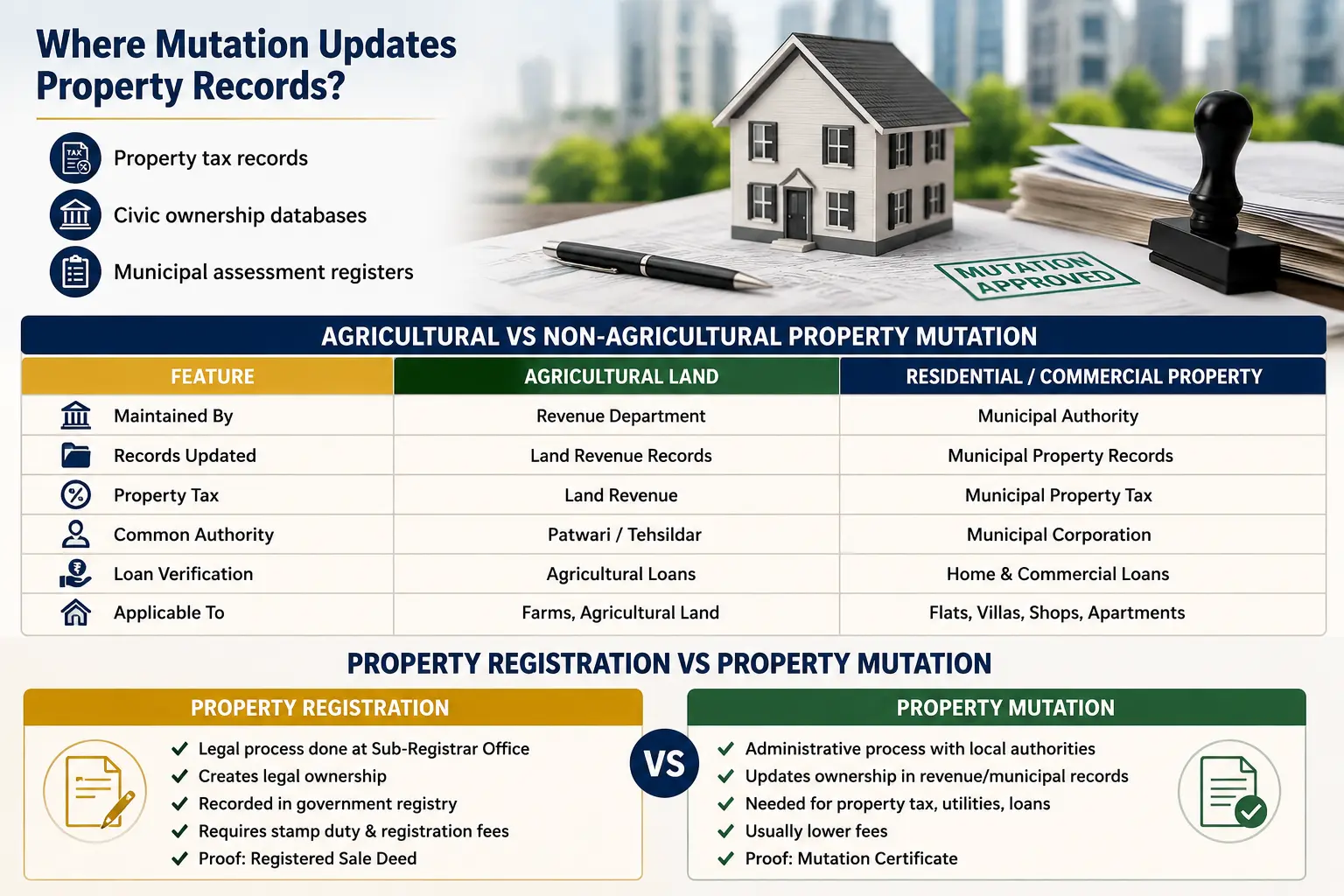
| Feature | Agricultural Land | Residential / Commercial Property |
| Maintained By | Revenue Department | Municipal Authority |
| Records Updated | Land Revenue Records | Municipal Property Records |
| Property Tax | Land Revenue | Municipal Property Tax |
| Common Authority | Patwari / Tehsildar | Municipal Corporation |
| Loan Verification | Agricultural Loans | Home & Commercial Loans |
| Applicable To | Farms, Agricultural Land | Flats, Villas, Shops, Apartments |
Property Registration vs Property Mutation
Many buyers confuse these two processes because both occur after purchasing a property.
However, they serve completely different purposes.
Property Registration
Property registration is the legal process of recording ownership through a registered document.
It involves:
- Execution of Sale Deed
- Payment of Stamp Duty
- Registration Charges
- Sub-Registrar Verification
After registration:
You legally become the property’s owner.
Property Mutation
Mutation is the administrative process of updating ownership details in government records.
It involves:
- Updating municipal records
- Updating land revenue records
- Changing property tax ownership
- Recording the new owner for administrative purposes
Property Registration vs Property Mutation (Comparison Table)
| Parameter | Property Registration | Property Mutation |
| Purpose | Legal transfer of ownership | Administrative update of records |
| Proof of Ownership | Yes | No |
| Mandatory | Yes | Highly recommended (often required administratively) |
| Authority | Sub-Registrar Office | Municipal Corporation / Revenue Department |
| Main Document | Sale Deed | Mutation Certificate |
| Updates Government Records | Partially | Yes |
| Updates Property Tax | No | Yes |
| Required for Home Loans | Yes | Often requested |
| Helps During Resale | Yes | Yes |
| Establishes Legal Title | Yes | No |
Mutation vs Khata vs Registry
These three terms are often misunderstood, especially by first-time homebuyers.
| Term | Purpose |
| Registry | Legally records ownership through the Sale Deed |
| Mutation | Updates government land or municipal records after ownership transfer |
| Khata | Municipal account used mainly for property tax assessment and civic records (applicable in states where the Khata system exists) |
Simply put:
- Registry proves ownership.
- Mutation updates government ownership records.
- Khata helps manage municipal taxation and civic services.
When is Property Mutation Required?
Property mutation should generally be completed whenever ownership changes.
Common situations include:
After Buying Property
The most common reason for mutation is purchasing:
- Flats
- Villas
- Residential plots
- Commercial property
- Agricultural land
After Inheritance
If property passes to legal heirs through succession or inheritance, mutation updates government records accordingly.
After Gift Deed
When property is gifted to another person, mutation ensures that official records reflect the new owner.
After Partition
Family property divided among legal heirs should be mutated to avoid future ownership disputes.
After Court Orders
If ownership changes through a court decree, mutation should be completed based on the final judgment.
After Will Execution
When ownership transfers according to a valid will, legal heirs should update government records through mutation after completing the applicable legal formalities.
Expert Tip
Apply for property mutation as soon as the ownership transfer is completed. Delaying the process can result in outdated government records, tax-related issues, and complications during resale, inheritance, or loan approvals.
What is the Procedure for Mutation of Property?
The procedure for mutation of property involves submitting a mutation application along with ownership documents to the concerned municipal authority or revenue department. After document verification, property inspection (if required), and payment of applicable fees, the authority updates the new owner’s name in government records and issues a Mutation Certificate.
Many property owners ask:
- What is the procedure for mutation of property?
- How do I apply for property mutation?
- Can property mutation be done online?
The good news is that the process has become much easier in recent years. Many Indian states now offer online property mutation services through their official land records or municipal portals.
However, the exact procedure may vary slightly depending on the state, city, and the type of property (flat, residential plot, commercial property, or agricultural land).
Step-by-Step Property Mutation Process
Step 1: Complete the Property Transfer
Before applying for mutation, ownership must already be legally transferred through a valid document such as:
- Registered Sale Deed
- Gift Deed
- Partition Deed
- Registered Will (where applicable)
- Court Order
- Succession Certificate (where applicable)
Without a valid ownership transfer document, the mutation application is generally not processed.
Step 2: Obtain the Mutation Application Form
The application form can usually be obtained through:
Offline
- Municipal Corporation
- Nagar Nigam
- Revenue Department
- Tehsil Office
- Land Revenue Office
Online
Most states now provide online services through their official land records or municipal portals.
Examples include:
- State Land Records Portal
- Municipal Corporation Portal
- Urban Development Authority Portal
- Digital Property Record Systems
Always use the official government website of your respective state or local authority.
Step 3: Fill Out the Mutation Application
The application generally asks for:
- Applicant Name
- Father’s / Husband’s Name
- Mobile Number
- Aadhaar Number (where applicable)
- Property Address
- Survey Number / Plot Number
- Khata Number (if applicable)
- Registration Number
- Sale Deed Details
- Mode of Property Transfer
- Property Category
- Previous Owner Details
Always ensure the information exactly matches your registered property documents.
Step 4: Attach Supporting Documents
The mutation application must be supported by relevant ownership documents.
Common Documents Required
- Registered Sale Deed
- Property Registration Copy
- Identity Proof
- Aadhaar Card
- PAN Card
- Passport (for NRIs, where applicable)
- Address Proof
- Latest Property Tax Receipt
- Electricity Bill (if required)
- Encumbrance Certificate (state-specific)
- No Objection Certificate (where applicable)
Additional Documents (Depending on the Case)
For Inheritance
- Death Certificate
- Legal Heir Certificate
- Succession Certificate
- Probate of Will (if applicable)
For Gift Deed
- Registered Gift Deed
- Donor Identity Proof
- Donee Identity Proof
For Partition
- Registered Partition Deed
- Family Settlement Agreement
- Court Decree (if applicable)
Expert Tip
Before submission, verify that:
- Names are identical across all documents.
- Property dimensions match the registered deed.
- Survey or plot numbers are correct.
- There are no unpaid property tax dues.
Most mutation applications are delayed due to simple documentation errors.
Step 5: Submit the Application
After completing the form:
- Submit all required documents.
- Pay the applicable mutation fee.
- Obtain an acknowledgment receipt or application number.
This reference number will be required later to track your mutation status.
Step 6: Verification by Authorities
Once your application is submitted, the concerned authority begins verification.
This may include:
Document Verification
Officials verify:
- Sale Deed
- Property Registration
- Tax Receipts
- Identity Documents
- Ownership History
Property Inspection (If Required)
In some jurisdictions, officials may conduct a physical inspection to verify:
- Property location
- Property boundaries
- Current possession
- Existing construction
- Survey details
Not every mutation application requires a site inspection. It depends on local regulations and the type of property.
Step 7: Public Notice (Applicable in Some States)
Certain states issue a public notice inviting objections before approving the mutation.
If no valid objection is received within the prescribed period, the mutation process continues.
This helps prevent fraudulent ownership claims.
Step 8: Approval of Mutation
Once all verifications are complete:
- Revenue records are updated.
- Municipal records are updated.
- Property tax ownership changes.
- Government databases reflect the new owner.
The mutation application is then approved.
Step 9: Issue of Mutation Certificate
After approval, the concerned authority issues the Mutation Certificate.
The certificate generally includes:
- Owner’s Name
- Property Address
- Survey Number
- Mutation Number
- Date of Mutation
- Type of Transfer
- Revenue Office Details
- Official Approval
This document confirms that government records have been updated.
Flowchart: Property Mutation Process
Property Purchase / Transfer
│
▼
Property Registration
│
▼
Collect Required Documents
│
▼
Fill Mutation Application
│
▼
Submit Application
│
▼
Pay Mutation Fees
│
▼
Document Verification
│
▼
Site Inspection (if required)
│
▼
Approval
│
▼
Government Records Updated
│
▼
Mutation Certificate Issued
Documents Required for Property Mutation
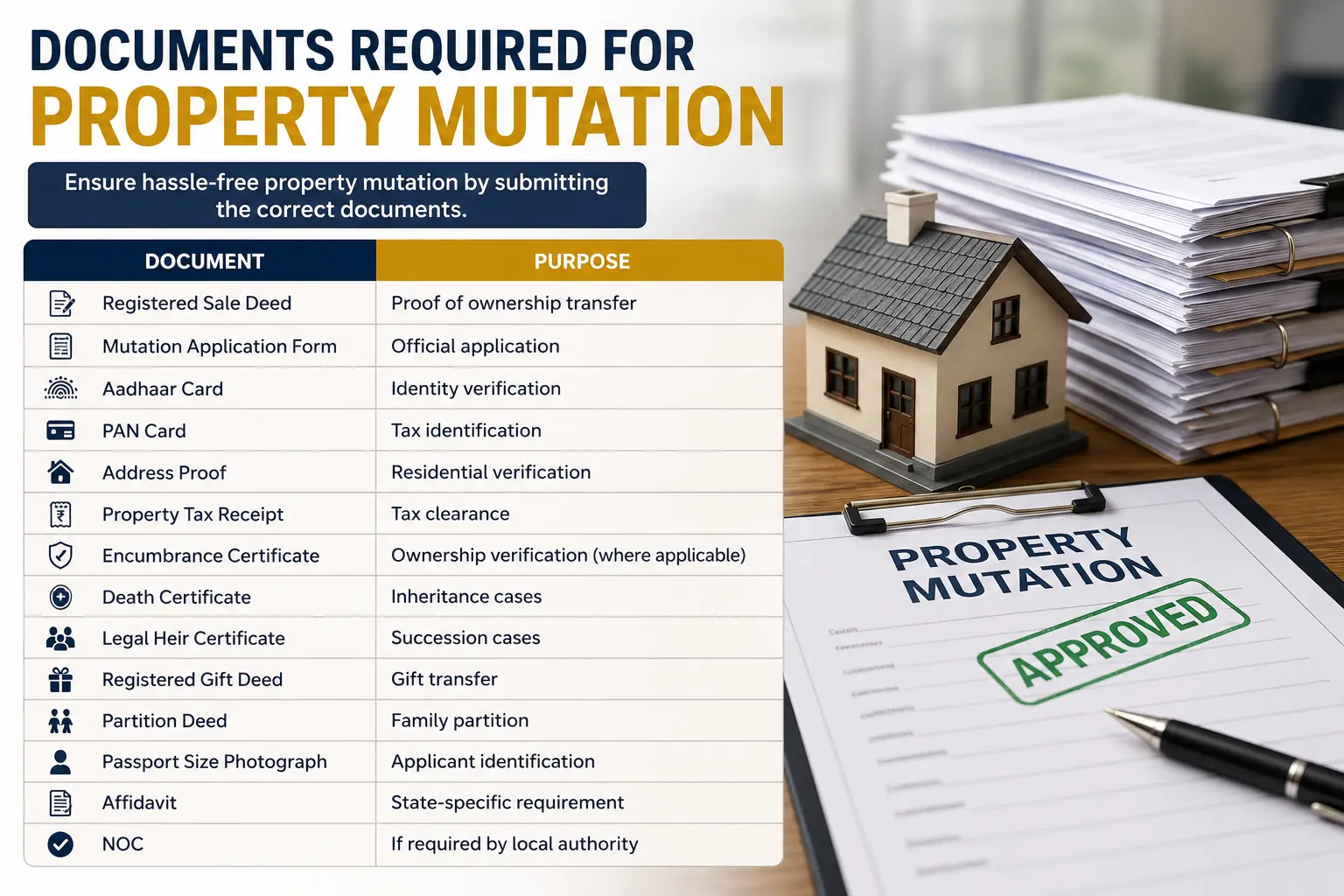
The required documents may vary slightly across states, but the following are commonly requested:
| Document | Purpose |
| Registered Sale Deed | Proof of ownership transfer |
| Mutation Application Form | Official application |
| Aadhaar Card | Identity verification |
| PAN Card | Tax identification |
| Address Proof | Residential verification |
| Property Tax Receipt | Tax clearance |
| Encumbrance Certificate | Ownership verification (where applicable) |
| Death Certificate | Inheritance cases |
| Legal Heir Certificate | Succession cases |
| Registered Gift Deed | Gift transfer |
| Partition Deed | Family partition |
| Passport Size Photograph | Applicant identification |
| Affidavit | State-specific requirement |
| NOC | If required by local authority |
Property Mutation Fees
Property mutation fees vary by state, local authority, and property type. In many jurisdictions, the fee is nominal, while some states calculate charges based on property value or local municipal rules.
What Determines the Fee?
Mutation charges may depend on:
- State Government Rules
- Municipal Corporation
- Property Category
- Residential vs Commercial
- Agricultural vs Non-Agricultural Land
- Urban or Rural Location
Some states also levy the following:
- Processing Fees
- Service Charges
- Inspection Charges
- Online Convenience Fees (where applicable)
Always check the latest fee schedule on your state government’s official portal before applying.
How Long Does Property Mutation Take?
The timeline depends on:
- State
- City
- Property Type
- Verification Process
- Document Completeness
Under normal circumstances, many applications are processed within a few weeks, though actual timelines vary by jurisdiction.
Applications with incomplete documents, pending taxes, or ownership disputes may take longer.
Factors That Can Delay Mutation
- Incorrect documents
- Name mismatch
- Pending property tax
- Legal disputes
- Survey number errors
- Missing succession documents
- Public objections (where applicable)
Expert Recommendation
Keep both your Registered Sale Deed and Mutation Certificate safely. The Sale Deed is your legal proof of ownership, while the Mutation Certificate demonstrates that government records have been updated for taxation and administrative purposes.
How to Apply for Property Mutation Online?
You can apply for property mutation online by visiting your state’s official land records or municipal corporation portal, filling out the mutation application, uploading the required documents, paying the prescribed fee, and tracking your application using the reference number provided after submission.
The Government of India has encouraged states to digitize land records through initiatives like the Digital India Land Records Modernization Programme (DILRMP). As a result, many states now allow property owners to apply for mutation online, making the process faster, more transparent, and reducing the need for repeated office visits.
Important: The online process differs from state to state. Always use your respective state government’s official land records or municipal portal.
Step-by-Step Online Property Mutation Process
Step 1: Visit the Official Government Portal
Go to your state’s:
- Land Records Portal
- Revenue Department Portal
- Municipal Corporation Website
- Urban Local Body Portal
Examples include:
- State Land Record Portal
- Municipal Property Tax Portal
- Urban Development Authority Portal
Never apply through unofficial websites.
Step 2: Register or Login
Create an account using:
- Mobile Number
- Email Address
- Aadhaar (where required)
- OTP Verification
Step 3: Select “Property Mutation”
Most portals provide services such as:
- Property Mutation
- Khata Transfer
- Ownership Update
- Revenue Record Update
Select the appropriate option based on your property type.
Step 4: Fill Property Details
Enter:
- Property Address
- Survey Number
- Plot Number
- Khata Number (if applicable)
- Registration Number
- Previous Owner
- New Owner
- Mode of Transfer
Step 5: Upload Required Documents
Upload scanned copies of:
- Registered Sale Deed
- Aadhaar
- PAN
- Property Tax Receipt
- Address Proof
- Other supporting documents
Ensure all files are clear and readable.
Step 6: Pay the Mutation Fee
Most portals support:
- UPI
- Net Banking
- Debit Card
- Credit Card
Save the payment receipt for future reference.
Step 7: Receive Application Number
After successful submission:
- An Application ID
- Mutation Reference Number
- Acknowledgement Receipt
will be generated.
Keep these details safely.
Step 8: Track Your Application
Use the Application Number to check:
- Pending
- Under Verification
- Approved
- Rejected
Many portals also send updates via SMS or email.
How to Check Property Mutation Status Online?
To check your property mutation status, visit your state’s official land records or municipal portal, enter your application number or property details, and view the current status of your mutation request.
Most government portals provide real-time tracking.
You may need:
- Application Number
- Property ID
- Survey Number
- Registration Number
- Mobile OTP
Possible status updates include:
- Application Submitted
- Documents Under Verification
- Inspection Scheduled
- Pending Clarification
- Approved
- Rejected
What Should You Do If the Status Doesn’t Change?
If your application remains pending for an unusually long period:
- Contact the concerned municipal office or revenue department.
- Verify whether any additional documents are required.
- Ensure there are no unpaid property taxes or document discrepancies.
- Preserve your acknowledgement receipt and payment proof.
What is a Mutation Certificate?
A Mutation Certificate is an official document issued by the municipal or revenue authority after approving a mutation application. It confirms that the new owner’s name has been updated in government land or municipal records for administrative and taxation purposes.
Information Included in a Mutation Certificate
A typical certificate contains:
- Mutation Number
- Owner’s Name
- Previous Owner
- Property Address
- Survey Number
- Plot Number
- Date of Approval
- Type of Transfer
- Revenue Office Details
- Official Seal or Digital Verification
Why is the Mutation Certificate Important?
Although it is not proof of ownership, it serves as valuable evidence that:
- Government records have been updated.
- Property tax liabilities have shifted to the new owner.
- Municipal databases are current.
Many banks and prospective buyers request a mutation certificate during property verification.
Karnataka Automatic Property Mutation System (2026)
One of the most significant reforms in property administration has been introduced in Karnataka, where the mutation process has been integrated with property registration through digital land records.
What Changed?
Earlier:
- Buyers had to register the property.
- Submit a separate mutation application.
- Wait for manual verification.
Now, in many eligible cases:
- Registration data is electronically shared with the land records system.
- Mutation is initiated automatically after registration, subject to applicable rules and verification.
- Administrative delays are reduced.
This digital integration has improved transparency and reduced paperwork for many property owners.
Benefits of the Automatic Mutation System
- Faster record updates
- Reduced manual intervention
- Better transparency
- Lower chances of clerical errors
- Simplified ownership updates
- Improved access to digital land records
This model is expected to encourage similar reforms in other states over time.
State-wise Property Mutation Process
While the core objective remains the same across India, the authority responsible for mutation and the exact process differ by state.
| State | Primary Authority |
| Haryana | Revenue Department / Municipal Corporation |
| Delhi | Municipal Corporation |
| Uttar Pradesh | Revenue Department |
| Rajasthan | Revenue Department |
| Punjab | Revenue Department |
| Karnataka | Revenue Department & Digital Land Records |
| Maharashtra | Municipal Corporation / Revenue Department |
| Telangana | Revenue Department |
| Andhra Pradesh | Revenue Department |
| Tamil Nadu | Revenue Department |
Applicants should always follow the latest guidelines issued by their respective state authorities.
Latest Digital Initiatives Improving Property Mutation
Several government initiatives have improved transparency and efficiency in land administration, including:
- Digitization of land records
- Online mutation applications
- Digital property tax systems
- Online document verification
- GIS-based land mapping (in some states)
- Integration of registration and land records in select jurisdictions
These reforms aim to reduce fraud, improve public access to records, and simplify property transactions.
Expert Tip
Complete the mutation process as soon as your property registration is finalized. Early mutation helps ensure that government records, tax records, and administrative databases are updated before future transactions such as resale, inheritance, or loan applications.
Common Mistakes to Avoid During Property Mutation
Many property owners delay or incorrectly complete the mutation process, leading to avoidable legal and administrative issues. Here are the most common mistakes and how to avoid them.
1. Assuming Property Registration Is Enough
The biggest misconception is believing that a registered sale deed automatically updates all government records.
Reality: Registration records the ownership transfer, but mutation updates the ownership details in municipal or land revenue records for administrative and taxation purposes.
2. Delaying the Mutation Application
Many buyers wait months or even years before applying.
This can lead to:
- Property tax notices being issued in the previous owner’s name.
- Difficulty during resale.
- Delays in loan approvals.
- Additional paperwork.
Expert Tip: Apply for mutation soon after completing property registration and obtaining the registered documents.
3. Submitting Incorrect Documents
Applications are often delayed because of:
- Incorrect survey numbers.
- Mismatched owner names.
- Expired ID proofs.
- Missing supporting documents.
Always cross-check every document before submission.
4. Ignoring Outstanding Property Taxes
Many authorities require that property tax dues be cleared before processing mutation.
Before applying:
- Verify all outstanding taxes.
- Keep the latest tax payment receipt ready.
5. Ignoring Local Rules
Every state follows its own procedures.
For example:
- Some states require field inspections.
- Some issue public notices.
- Others have online-only applications.
Always verify the latest procedure from the concerned authority.
Myths vs Facts About Property Mutation
| Myth | Fact |
| Mutation proves ownership. | No. A registered sale deed or other valid title document establishes ownership. Mutation updates administrative records. |
| Registration and mutation are the same. | They are separate processes with different purposes. |
| Mutation is required only for land. | It may also apply to flats, apartments, houses, and commercial properties, depending on local rules. |
| Property tax automatically changes after registration. | Not always. Mutation or related municipal procedures may still be required. |
| Mutation can never be corrected. | Incorrect mutation entries can often be challenged or corrected through the competent authority. |
| Online mutation is available everywhere. | Availability depends on the state and local authority. |
Does Property Mutation Prove Ownership?
No. Property mutation does not prove legal ownership. It only updates the owner’s name in government land or municipal records for administrative and taxation purposes. The registered sale deed or other valid title document remains the primary legal proof of ownership.
Can Property Be Sold Without Mutation?
Yes, a property can sometimes be sold even if mutation has not been completed, because ownership is generally established through the registered title documents. However, many buyers, banks, and legal advisors prefer updated mutation records, which can make the transaction smoother.
What Happens If Property Mutation Is Not Done?
Failure to complete mutation may result in:
- Outdated municipal or revenue records.
- Property tax notices continuing in the previous owner’s name.
- Additional verification during resale.
- Delays in certain loan or inheritance processes.
- Administrative complications if ownership records are inconsistent.
Although the registered sale deed remains the primary ownership document, maintaining updated government records is considered a good practice.
Expert Tips from Real Estate Professionals
Keep Multiple Copies
Store:
- Registered Sale Deed
- Mutation Certificate
- Property Tax Receipts
- Encumbrance Certificate
- Khata (if applicable)
Both digital and physical copies are useful.
Verify the Seller’s Documents
Before purchasing:
- Review the title documents.
- Check tax receipts.
- Verify whether previous ownership records have been properly updated.
- Confirm there are no pending disputes.
Check Official Records
After approval:
Verify that:
- Owner’s name
- Survey number
- Plot number
- Property address
- Area measurements
are correctly reflected in the official records.
Monitor Your Application
Even if you apply online, periodically check the application status. Promptly respond if the authority requests clarification or additional documents.
Property Buyer’s Mutation Checklist
Before Applying:
- Registered Sale Deed available
- Property Tax cleared
- Aadhaar/PAN ready
- Address proof available
- Supporting documents collected
- Correct survey number verified
- Property details verified
- Application form completed
After Approval:
- Mutation Certificate received
- Government records updated
- Property tax records updated
- Digital copy downloaded (if available)
- Certificate stored safely
Frequently Asked Questions (FAQ)
1. What is mutation of property?
Property mutation is the process of updating the new owner’s name in government land or municipal records after ownership changes through a sale, inheritance, gift, partition, or other legally recognized transfer.
2. What is property mutation?
Property mutation is another term for mutation of property. It refers to updating official government records after a change in ownership.
3. What is mutation of flat?
Mutation of a flat involves updating the new owner’s details in municipal records after purchasing, inheriting, or receiving an apartment.
4. What is mutation of land?
Land mutation updates ownership information in revenue records maintained by the relevant land administration authority after ownership changes.
5. What is the procedure for mutation of property?
The process generally involves:
- Completing the ownership transfer.
- Submitting a mutation application.
- Providing supporting documents.
- Verification by the authority.
- Payment of applicable fees.
- Updating government records.
- Issuance of the Mutation Certificate.
6. Is property mutation compulsory?
The legal position varies by state and property type. While the registered sale deed establishes ownership, mutation is widely recommended because it updates government records and simplifies taxation, resale, and other administrative processes.
7. How long does property mutation take?
The processing time depends on the state, local authority, document verification, and whether inspections or public notices are required.
8. Can mutation be completed online?
Many states now provide online mutation facilities through official land records or municipal portals, although availability differs across jurisdictions.
9. What documents are required?
Common documents include:
- Registered Sale Deed
- Identity Proof
- Address Proof
- Property Tax Receipt
- Application Form
Additional documents may be required depending on the mode of transfer.
10. Does mutation increase property value?
No. Mutation does not affect the market value of a property. It only updates government records.
11. Is mutation required after inheritance?
In most cases, legal heirs should update the government records after completing the applicable legal formalities for succession.
12. Can mutation be corrected?
Yes. If there is an error in the mutation record, the concerned authority generally provides a process to request corrections, subject to verification.
Conclusion
Property mutation is an important administrative step that helps keep government land and municipal records accurate after a property changes hands. Whether you’ve purchased a flat, inherited ancestral land, received a property through a gift deed, or acquired commercial real estate, updating official records helps ensure smoother tax administration, future transactions, and record management.
While a registered sale deed remains the primary legal proof of ownership, completing the mutation process reflects the ownership change in government records and can reduce complications during resale, inheritance, or financial transactions.
Before applying, always check the latest rules and procedures issued by your state government or local authority, as requirements and timelines can vary across India.
Also Read:
- What is RERA and How Does It Protect Homebuyers in India 2026
- 10 Things to Check Before Buying an Apartment
- What is Carpet Area vs Built-up Area vs Super Built-up Area
- What is Circle Rate in Gurgaon
- What is Property Registry in India?
- What is Stamp Duty and Registration Charges in Gurgaon?
- What is Freehold vs Leasehold Property
- What is Occupancy Certificate
- What is Land Use?
- Best Griha Pravesh Muhurat in 2026



Join The Discussion