

 by
by 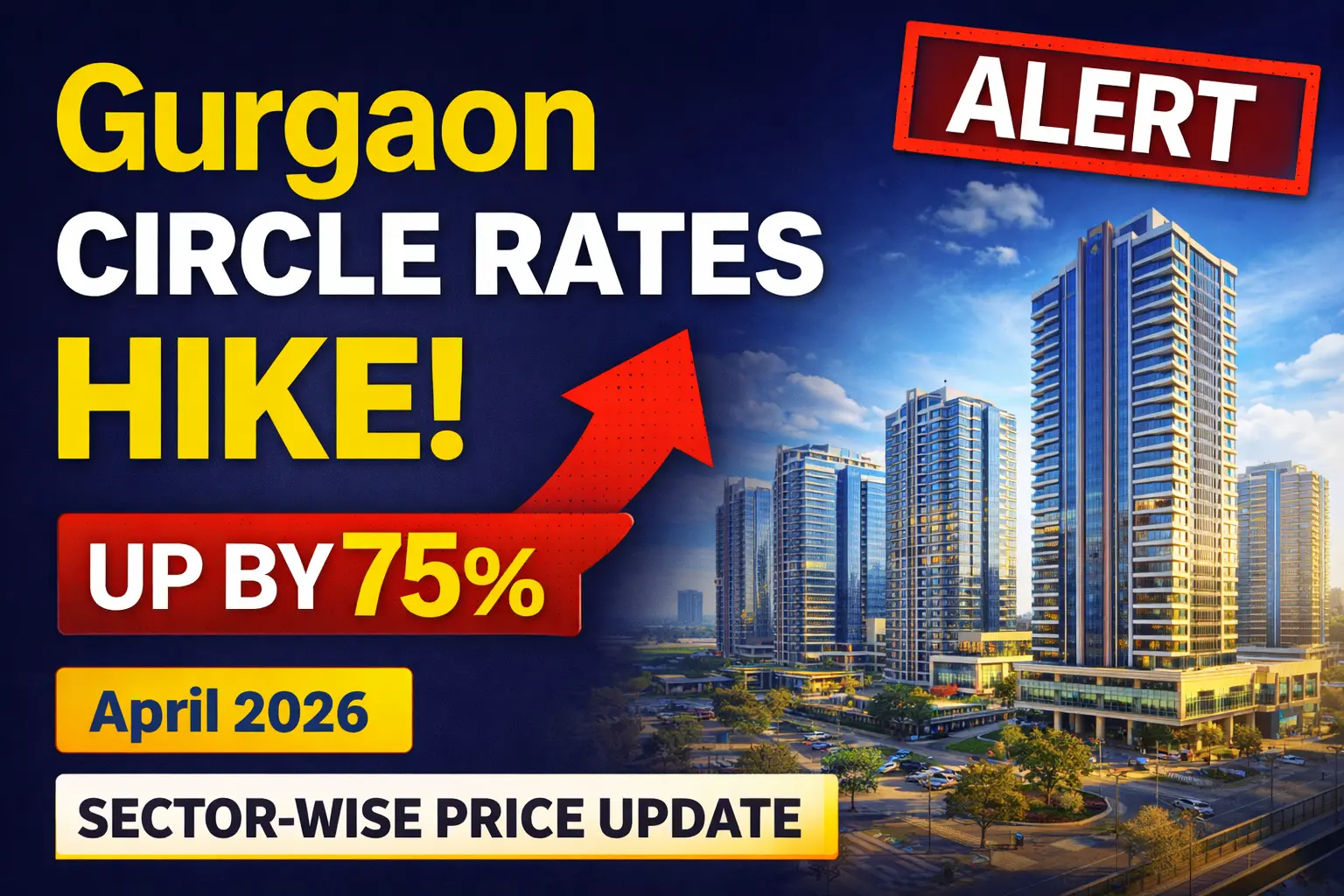
Gurgaon real estate has entered a new pricing phase. With the latest revision in official collector rates, Gurgaon circle rates increased up to 75% in April 2026, making property registration more expensive and pushing the market closer to actual transaction values. For homebuyers, investors, commercial buyers, and even landowners, this is not a minor policy change. It directly affects acquisition cost, stamp duty, registration value, and future resale benchmarks.
The latest Gurugram circle rates increase by up to 75% comes at a time when the city is already witnessing strong end-user and investor demand. Gurgaon continues to benefit from airport connectivity, corporate office concentration, industrial growth, and expanding infrastructure corridors such as Dwarka Expressway, Southern Peripheral Road, Golf Course Extension Road, New Gurgaon, and Manesar. Because of this, the government’s move is being seen as an attempt to align official rates more closely with prevailing market values.
For anyone planning to buy property in the city, this update matters immediately. Circle rates are the minimum value at which a property can be registered. Buyers pay stamp duty on the circle rate or the transaction value, whichever is higher. So when official rates move up sharply, the cost of entering the market also rises.
In this detailed guide, we will explain what the new Gurgaon circle rate hike means, which sectors have seen the biggest jump, what experts are saying, how this affects property registration cost, and which micro-markets may continue to outperform after the revision. If you are searching for the latest Gurgaon circle rate 2026, sector-wise circle rate Gurgaon April 2026, Gurgaon circle rate increase 2026, or the impact of circle rate increase on property prices Gurgaon, this article will give you a complete picture.
What Are Circle Rates and Why Do They Matter?
Before understanding the latest revision, it is important to know what circle rates actually mean.
Circle rates are the minimum property values fixed by the government for registration purposes. In simple terms, no property transaction can legally be registered below this benchmark value. If the buyer and seller agree on a lower price, the registration and stamp duty calculation will still be based on the official circle rate if that rate is higher.
This is why circle rates matter so much in a market like Gurgaon:
- They directly affect stamp duty and registration cost
- They influence official property valuation
- They reduce undervaluation in sale transactions
- They narrow the gap between registry value and actual deal value
- They can reshape future asking prices in fast-growing sectors
For years, many Gurgaon locations had a large difference between market value and official registration value. That gap helped some buyers save on registration-related costs, but it also created valuation distortion. The new revision signals a stronger push toward market-aligned pricing.
So, when we say Gurgaon circle rates increased up to 75% in April 2026, we are also saying that the entry cost, tax cost, and transaction structure of buying property in the city may change meaningfully.
Why the Gurugram Circle Rate Increase Came in 2026
The timing of this increase is not random. Gurgaon has been one of the strongest-performing real estate markets in NCR, and several structural drivers have kept demand high.
1. Airport-led demand
The city’s proximity to Delhi airport continues to support residential, rental, and commercial demand, especially in sectors connected through major road networks and premium corridors.
2. Corporate and office concentration
Gurgaon remains a major employment hub with strong absorption from IT, consulting, finance, startups, and MNC-driven office demand. This keeps buyer interest alive across both luxury and mid-segment zones.
3. Infrastructure growth
Dwarka Expressway, SPR, Golf Course Extension Road, New Gurgaon, and Manesar have all seen improving infrastructure, which has changed buyer perception and developer pricing power.
4. Market-price alignment
Experts believe the administration is trying to reduce the difference between circle rates and real market prices. This makes official valuation more realistic and strengthens transparency in the system.
5. Strong end-user and investor participation
Unlike speculative spikes of the past, many Gurgaon micro-markets are now seeing deeper end-user acceptance along with investor confidence. That gives the administration more room to revise circle rates upward.
This is why the Gurugram circle rates increase by up to 75% should be read not just as a cost hike, but also as a signal that the city’s pricing structure is entering a more formal and market-linked phase.
Gurgaon Circle Rate 2026: The Big Picture
The Gurgaon circle rate 2026 revision is not uniform across the city. Some mature sectors have seen moderate increases, while growth corridors and premium pockets have seen much sharper hikes.
Experts tracking the change say that the new predictive collector rate revisions indicate a structured move to align official pricing with prevailing market values. The rise ranges from 15% in relatively stable locations to as high as 75% in high-growth or underpriced corridors.
This creates three broad patterns across Gurgaon:
Established but stable sectors
These areas are seeing moderate changes because the market is already mature and pricing is relatively well established.
High-growth infrastructure corridors
These locations are seeing the biggest jumps because infrastructure and buyer demand have outpaced older circle rate assumptions.
Premium micro-markets
Luxury and strategic commercial belts are also witnessing strong upward revisions, reinforcing their high-value positioning.
For buyers, this means you cannot look at Gurgaon as one single market anymore. The effect of the circle rate increase depends entirely on which corridor, sector, and asset type you are targeting.
Sector-Wise Circle Rate Gurgaon April 2026: Key Price Updates
Now let us break down the sector-wise circle rate Gurgaon April 2026 revision in a practical way.
Dwarka Expressway: One of the Biggest Gainers
Dwarka Expressway continues to lead Gurgaon’s growth narrative, and this corridor has emerged as one of the biggest beneficiaries of the latest revision.
- Commercial rates are expected to rise 75% to around Rs 2,04,750 per sq. yard
- Residential sectors between 104 and 115 may see around 30% increase to nearly Rs 2,24,796 per sq. yard
This is significant because the corridor was already benefiting from improved connectivity, airport access, and growing buyer interest. The revised official values now support the narrative that Dwarka Expressway is no longer an “upcoming” story alone. It is now being treated as a high-potential, maturing real estate corridor.
For investors, this matters in two ways:
- upfront transaction cost increases
- official value support strengthens long-term pricing perception
For end-users, the concern is affordability. Even if actual market prices were already higher, a higher circle rate means higher registration-related outflow.
Southern Peripheral Road: Strong Revision in a Growth Corridor
Southern Peripheral Road, or SPR, is another major growth belt where the Gurgaon circle rate increase 2026 has been strong.
- Residential rates in sectors 63, 63A, 64 and 67 may rise 45% to Rs 84,825 per sq. yard
- Nearby sectors such as 62, 65, 66 and 69 to 72 may see around 30% increase to Rs 91,000 per sq. yard
This pattern clearly shows that SPR is no longer being treated as just a spillover corridor. The official revision recognizes its improving infrastructure, location advantage, and rising market relevance.
From an investment perspective, SPR remains important because it offers a mix of residential demand, modern developments, and future appreciation potential. But the latest official valuation also means investors entering now need to be more selective about project quality and acquisition price.
If you are evaluating how circle rate increase affects property prices Gurgaon, SPR is one of the clearest examples. Even if builder pricing does not jump immediately in the same proportion, registration cost certainly becomes higher, and that influences total acquisition cost.
Golf Course Extension Road: Premium Market Gets Another Push
Golf Course Extension Road has already established itself as one of Gurgaon’s most premium residential corridors. The new revision only strengthens this positioning.
- Circle rates in this belt may see around 30% increase
- Official values may move to around Rs 91,000 per sq. yard
This is not surprising. Golf Course Extension Road has strong demand from premium buyers, NRIs, professionals, and investors looking for branded, well-located urban product. A 30% increase may seem lower than the 75% jump in some other pockets, but in a premium zone, even a 30% circle rate revision is materially important.
This update supports two conclusions:
- the corridor remains expensive for a reason
- the administration sees its market value as strong enough to justify higher official benchmarks
DLF Phase 5: Premium Areas See Steep Hike Too
Among luxury locations, DLF Phase 5 stands out as one of the most high-value addresses affected by the revision.
- Rates may record a 75% increase
- Official values may reach about Rs 1,85,000 per sq. yard
This is a major revision and shows that the premium market is not being left out of the new pricing approach. DLF Phase 5 has long been seen as an elite residential zone, and such a steep official increase reflects its strong positioning, limited premium stock, and sustained demand.
This also matters symbolically. When one of Gurgaon’s premium addresses gets such a strong upward revision, it reinforces the larger trend that official valuations are moving decisively toward real market behavior.
Sector 25 Commercial: Sharp 75% Jump
Commercial property has also seen meaningful revision, and Sector 25 commercial is among the most striking cases.
- Rates may rise 75%
- New benchmark may reach Rs 2,43,941 per sq. yard
This is important for business owners, office investors, landowners, and commercial developers. A 75% increase in official registration value changes the transaction economics substantially. It also supports the view that commercial real estate in strategic Gurgaon zones remains a strong high-value asset class.
Sector 15 Residential: A Key City Sector Under Watch
One of the most discussed revisions in this update is Sector 15 residential.
- Rates may rise 45%
- New values may go up to Rs 1,24,700 per sq. yard
This is a strong jump for a central, known, city-based residential location. It shows that even older established sectors are not completely insulated from the revision wave.
For buyers searching specifically for sector 15 Gurgaon property rate, this is a key update because it changes the registration base significantly. Sector 15 remains relevant for central-city buyers, and this revision underlines its continuing value in the urban structure of Gurgaon.
New Gurgaon: 104–115 Belt Continues to Strengthen
New Gurgaon has been one of the most watched housing markets in recent years, and the circle rate revision further validates that trend.
- Sectors in New Gurgaon may see around 30% increase
- Official values may reach about Rs 2,24,796 per sq. yard
This is substantial. New Gurgaon is no longer viewed only as a future play. With expanding residential inventory, improving roads, corporate influence, and stronger buyer familiarity, its official value structure is catching up fast.
For investors who entered early, this is positive from a benchmark perspective. For fresh buyers, this means the low-cost advantage is shrinking.
Sohna Group Housing: Moderate but Positive Increase
Sohna is seeing a lower increase compared to some of Gurgaon’s sharper-performing corridors, but it is still moving upward.
- Group housing areas may rise around 10%
- Official values may touch around Rs 63,000 per sq. yard
This suggests two things:
- Sohna still remains relatively more affordable in the broader regional context
- the administration acknowledges growth, but with more caution than in Gurgaon’s hotter corridors
For price-sensitive buyers, Sohna may still offer an alternative, but the market needs to be assessed carefully for project quality, delivery strength, and long-term connectivity value.
Manesar: Industrial and Residential Growth Story Continues
Manesar remains an important growth zone because of its industrial base, logistics relevance, and expanding residential catchment.
- Industrial rates in IMT Manesar may increase by around 30%
- Some residential pockets may see sharper gains due to connectivity and industrial activity
This is important because Manesar is not driven by the same demand dynamics as Golf Course Extension or DLF Phase 5. Its growth is more closely tied to employment generation, industrial activity, and peripheral connectivity.
As official values move up, the market gains more recognition as a serious regional growth engine rather than just an industrial extension.
What the Gurgaon Circle Rate Increase Means for Buyers
This is the most important question. Headlines are attention-grabbing, but buyers need clarity on actual impact.
1. Higher upfront cost
When Gurgaon circle rates increased up to 75% in April 2026, the immediate effect was on transaction cost. Since stamp duty is calculated on circle rate or deal value, whichever is higher, buyers in affected sectors will now have to budget more for registration.
2. Lower gap between official and market value
This can improve transparency in the long run. In many sectors, buyers and sellers had become used to large gaps between market value and registry value. That gap is narrowing.
3. Premium and growth sectors become even more selective
If official values rise sharply, weaker projects lose the affordability cushion that underpricing sometimes provided. Strong projects may still absorb demand, but weaker inventory may struggle.
4. Investors must rethink entry timing
In a higher official-value environment, the margin for casual speculative entry reduces. Buyers need better project selection, smarter payment structure, and stronger holding capacity.
5. End-users should calculate full acquisition cost
Not just BSP or resale price, but:
- stamp duty
- registration cost
- brokerage
- GST where applicable
- fit-out and furnishing
- maintenance and club charges
Expert View: Market-Aligned Pricing Is the Real Message
According to market commentary cited in the research, Kartikeya Sharma of Square Yards has said the 2026 revision reflects a shift toward market-aligned pricing, with circle rate increases ranging from 15% to 75% across Gurugram.
That observation is important because it explains the logic behind the move.
This is not just a revenue decision. It is also a valuation correction.
The key message is:
- growth corridors are getting stronger official backing
- emerging residential sectors are being re-rated
- mature sectors are being stabilized, not ignored
- official pricing is moving closer to real deal pricing
That, in turn, has long-term implications for transparency, taxation, and investment planning.
Why Some Sectors Saw 75% Hikes While Others Saw 15%–30%
This is where the revision becomes interesting from a market intelligence point of view.
75% increase zones
These are usually areas where:
- infrastructure has changed the market perception dramatically
- commercial potential is very high
- official values were far behind real market sentiment
- future demand drivers are strong
30%–45% increase zones
These often include:
- growing residential sectors
- maturing corridors
- areas with active developer presence
- improving connectivity and broader end-user acceptance
15% increase zones
These are generally:
- stabilized markets
- mature central sectors
- locations where official values were already more aligned
- areas where market growth is steady, not explosive
This is why established locations like Sector 29 are seeing more moderate increases, while places like Dwarka Expressway and DLF-linked premium zones are seeing much sharper revision.
Impact on Stamp Duty and Registration Cost
One of the biggest practical effects of the revision is on stamp duty. Buyers often focus on property price but ignore how official value changes affect transaction cost.
Let us understand with a simple example.
Suppose the official circle rate of a property rises from Rs 80,000 to Rs 1,24,700 per sq. yard. Even if the deal value is negotiated well, the registration base itself becomes much higher. That means:
- stamp duty cost rises
- registration charges rise
- overall cheque component may increase
- initial capital outflow becomes heavier
So the impact of circle rate increase on property prices Gurgaon is not limited to resale or builder rates. It begins immediately with acquisition cost.
Will Home Prices Rise Further in Gurgaon?
The headline question many people are asking is: Gurugram circle rates increase by up to 75%: How much will home prices rise?
The answer depends on location, supply, and buyer category. But in general, three things are likely:
1. Registration cost will definitely rise
This is immediate and non-negotiable.
2. Market prices may gradually adjust upward in some pockets
Where official values were far below actual market prices, the direct price effect may be limited. But where the market uses official revisions as a sentiment trigger, quoted prices may rise further.
3. Construction cost pressure may add to the upward trend
The research also indicates that construction costs may move toward around Rs 2,100 per sq. foot, which can further support higher pricing in the near term.
This means Gurgaon may continue to see upward pricing pressure from both valuation correction and cost inflation.
Which Buyers Should Act Faster Now?
The latest revision does not affect every buyer in the same way.
End-users buying for self-use
If the purchase is long-term and the location is right, waiting only for a lower registration base may not help much in strong micro-markets.
Investors entering growth corridors
They need sharper sector and project selection now. Not every corridor will deliver equal upside after official re-rating.
Luxury buyers
In top-end belts, the revision reinforces premium market positioning. Transaction cost rises, but so does valuation support.
Plot and commercial buyers
These categories may feel the impact more aggressively because circle rates in some locations have moved very sharply.
Strategic Takeaways for 2026 Buyers and Investors
If you are planning to buy in Gurgaon after this update, keep these points in mind:
Focus on total acquisition cost, not just ticket size
A property that looks affordable at first may become significantly more expensive after registration-related cost is added.
Do not judge all sectors by one headline
A 75% hike in one corridor does not mean the same impact in every micro-market.
Prioritize quality corridors
If you are paying higher official value anyway, project quality, location quality, and livability become even more important.
Use circle rate movement as a market signal
Sharp official revision often indicates growing government confidence in that corridor’s real estate value.
Expect greater transparency
This may reduce some valuation opacity in the market and create more disciplined pricing benchmarks over time.
Final Conclusion
The latest revision marks an important shift in Gurgaon real estate. Gurgaon circle rates increased up to 75% in April 2026, and the impact is being felt across premium zones, growth corridors, New Gurgaon, commercial belts, and industrial nodes. From Dwarka Expressway to Southern Peripheral Road, from DLF Phase 5 to Sector 15 residential, the new benchmarks show that Gurugram’s official pricing structure is moving much closer to market reality.
For buyers, this means one thing very clearly: buying property in Gurgaon is now not just about market rate negotiation. It is also about understanding circle rate revisions, registration cost, sector-wise official value, and the future price direction of each micro-market.
If you are evaluating Gurgaon in 2026, treat this update as both a cost factor and a market signal. The city is becoming more expensive, yes. But it is also becoming more structured, more transparent, and more aligned with real demand patterns.
Also Read: What is Circle Rate in Gurgaon Real Estate?


Join The Discussion